
Degenerative Disc-Related Care
Disc changes show up differently in everyone, so we start with an exam and build the plan around what we find and what you want to keep doing.
Learn more →A Gentle, Motorized Approach to Disc-Related Care
Book your evaluation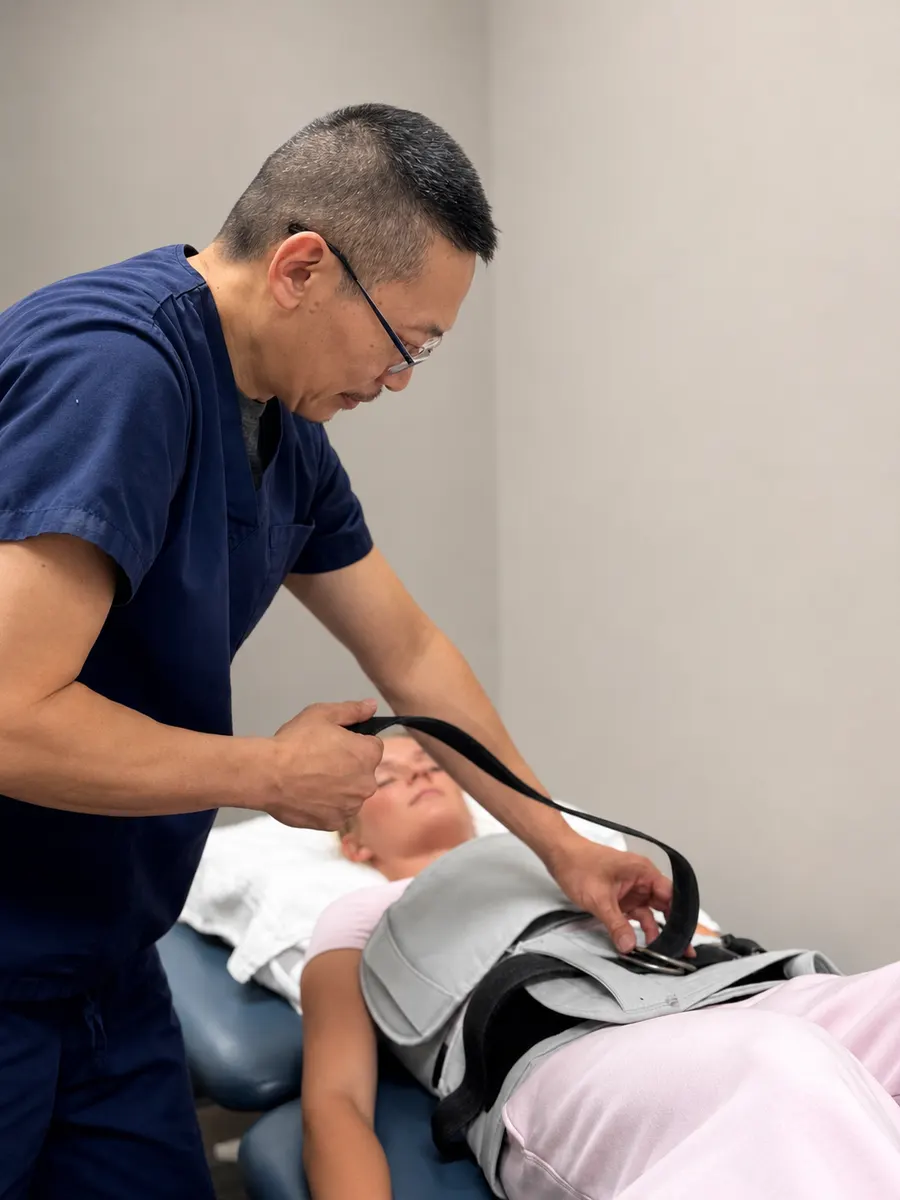
Spinal decompression uses a motorized traction table, a Chattanooga Triton DTS, to gently stretch and release the spine in slow, controlled cycles. The table applies a measured pull along the length of your spine, holds it briefly, eases off, then repeats that cycle for the rest of the session. It's designed to ease pressure between the vertebrae, and we use the table within the manufacturer's labeled indications.
Adams Chiropractic Health Center has cared for Plano families since 1978. Our doctors, Dr. Adams and Dr. Ow, offer spinal decompression at 3151 West 15th Street in Plano as a non-surgical option for disc-related pain, when your exam says it's a good fit.
It's built for people dealing with disc-related back or neck pain, especially when that pain travels down an arm or a leg. Patients are often considered for decompression when they have:
It isn't the right fit for everyone. Before we recommend it, we go through your history and exam findings together, and we'll tell you plainly whether decompression makes sense for your case or whether something else does. Results vary from person to person.
You stay dressed and lie on the table while it runs. Your chiropractor sets how much pull the table applies, how long each cycle holds, and how long the session lasts, then adjusts as we go based on how you're responding. Most people find it comfortable and relaxing.
If your back or neck pain began after a crash, see our auto injury care page. Decompression may be one part of a care plan when the exam supports it.
Spinal decompression is not covered by insurance, so it is a self-pay service. We keep our rates competitive, and we go over the full cost with you before you begin, so there are no surprises. Your exam and any other care you receive may be handled differently, and we are happy to check your specific coverage for those. Call (972) 596-1611 with any questions.
Most people describe it as a gentle stretch. You stay dressed and lie on the table while it runs, and your chiropractor can adjust the settings based on how you feel. If anything is uncomfortable, tell us right away and we will change it or stop.
Session length and the number of visits depend on your exam findings and how you respond, so we do not promise a set number up front. Dr. Adams or Dr. Ow will explain the plan before your first session and review it with you as you go.
It is used for disc-related back or neck pain, especially pain that travels into an arm or a leg. People are often referred to it for bulging or herniated discs, sciatica-type leg pain, and degenerative disc changes. Whether it fits your case is decided at the exam, not before it.
It is not right for everyone. Examples that usually rule it out include pregnancy, a recent spinal fracture, spinal tumor or infection, severe osteoporosis, an abdominal aneurysm, and some types of surgical hardware in the spine. We screen for these during your history and exam and tell you plainly if decompression is not appropriate.
Not always. We start with your history and a musculoskeletal exam. If your findings call for imaging, or you already have recent imaging, we will tell you. Bring any scans or reports you have to your first visit.
Spinal decompression is not covered by insurance, so it is self-pay. Our rates are competitive, and your total depends on the care plan your exam supports. We go over the cost with you before you start. Call (972) 596-1611 for details, or see our Good Faith Estimate information.
No. An adjustment is a hands-on movement of a specific joint. Decompression uses a motorized table that applies a measured, slow pull along the spine in repeating cycles. Some care plans use both, depending on your exam.
It is the motorized traction table we use for decompression. It applies controlled traction in cycles of pull and release, and we use it within the manufacturer's labeled indications.
Disc changes show up differently in everyone, so we start with an exam and build the plan around what we find and what you want to keep doing.
Learn more →Interferential current delivered on our LSI System IV, used alongside adjustments as part of a broader care plan and aimed at calming tight, irritated muscle.
Learn more →Hands-on care for the joints outside your spine, from shoulders and wrists to hips, knees, and feet, with a plan built on what your exam actually shows.
Learn more →Call (972) 596-1611 or book online. We'll get you seen fast.